- Membership |
- Shop |
- Calendar |
- Donate

A resource for reliable information about significant people, places, events, and things in Minnesota history.

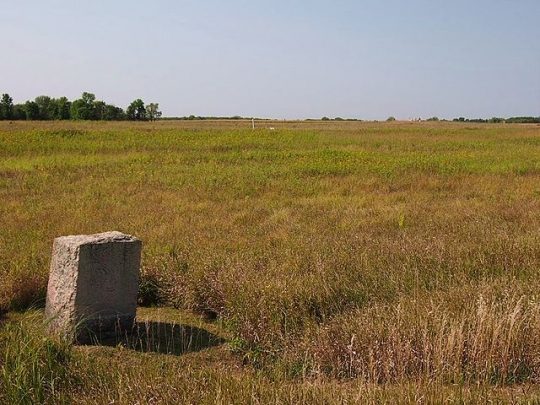
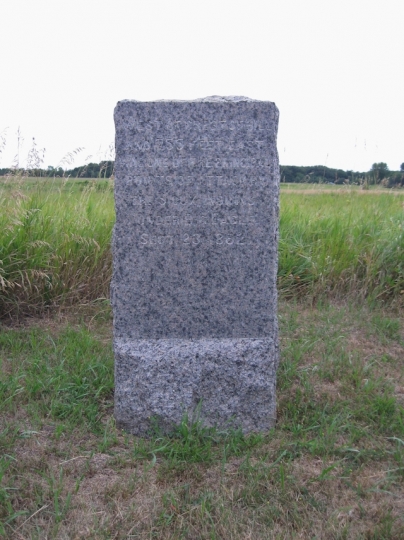
Marker erected by the Minnesota Valley Historical Society at the site of the Battle of Birch Coulee in Renville County, Minnesota. View from County Road 2 looking southwest. Photo by Wikimedia Commons user McGhiever, September 1, 2012. CC BY-SA 3.0.
The Battle of Birch Coulee, fought between September 2 and 3, 1862, was the worst defeat the United States suffered and the Dakotas' most successful engagement during the US–Dakota War of 1862. Over thirty hours, approximately 200 Dakota warriors pinned down a Union force of 170 newly recruited US volunteers, militia, and civilians from the area, who were unable to move until Henry Sibley's main army arrived.
The US–Dakota War of 1862, a formative event in the history of Minnesota, was initiated by factions of the Dakota who had endured years of repeatedly broken promises by the federal government and were starving as they waited for annuity payments owed to them. The Battle at Birch Coulee was the longest battle of the war.
After initial battles with Union soldiers and attacks on civilian settlers, Dakota fighters, under the command of Ta Oyate Duta (His Red Nation, also known as Little Crow), split off into two groups. The first, commanded by Ta Oyate Duta, went east. The other group, under Zitka Ta Hota (Gray Bird), moved toward New Ulm, with the goal of taking the city. With him were the leaders Hu Shasha (Red Legs), Wambdi Tanka (Big Eagle), and Maka To (Blue Earth). On their way there, they encountered a camp of US soldiers in a tactically weak position at Birch Coulee. Putting aside their aims for New Ulm, the two hundred Dakota fighters decided to attack at dawn on September 2.
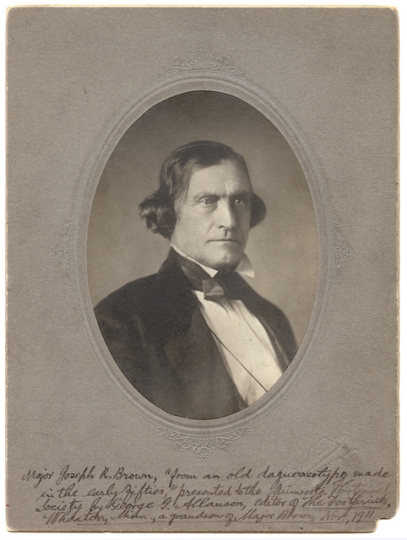
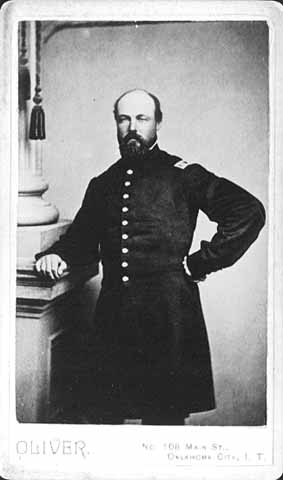
Two days earlier, on August 31, approximately 150 men under the command of Major Joseph Brown left Fort Ridgely to bury dead bodies from earlier attacks and seek out survivors. Brown had been a successful trader, but he was not an experienced military commander. After a day on burial detail, the force camped for the night on the prairie. The next day, the party continued their grisly task and discovered Justine Kreigher, a woman who had been wounded in earlier fighting. That night, Hiram Grant selected a camping site near water at Birch Coulee while Brown was away searching for signs of Dakota in the area. While soldiers under his command felt their position vulnerable, Grant was confident that there were no Dakota around.
The site would prove to be tactically unsound for the Union forces. The campsite was a short but significant distance from fresh water, and it was near trees and high grass that would provide cover for Dakota warriors. Grant also placed guard posts too close to camp for a warning to do any good. When morning arrived, the Dakota took advantage of the Union camp's weaknesses and attacked. Though spotted by a guard, they were able to severely damage the federal force within the first few minutes of the fighting. Most US casualties occurred during this critical time. The Dakota poured gunfire into the camp and killed nearly all of the horses there. Though he ultimately survived the battle, Brown was shot in the neck during these opening moments, and Joseph Anderson took charge of the defense. US soldiers dug rifle pits and used horse carcasses to shield themselves from the bullets.
Somewhat surprised by a Union force larger than they expected, the Dakota decided to wait while the sun and lack of water did their work on the besieged troops, rather than risk their own warriors on a frontal assault. The US soldiers spent the day pinned down by desultory fire and baking under the hot sun.
Hearing what his scouts thought might be the sound of gunfire, Colonel Henry Sibley sent Colonel Samuel McPhail with 240 men from Fort Ridgely to see what was happening. McPhail arrived at the siege hours into the battle, but was fooled by a ruse. Chief Mankato and a small force of Dakota warriors convinced McPhail that he faced several hundred Dakota fighters. Rather than engage the fight, McPhail chose to camp two miles away and send for help from the fort.
The next day, Sibley himself brought relief for the besieged men. When he approached with a large force, the Dakota fighters retreated. The US casualties in the battle were thirteen dead, almost fifty wounded, and ninety horses killed. Wamdi Tanka's account only mentions two deaths among their warriors.

Anderson, Clayton, and Alan R. Woolworth, eds. Through Dakota Eyes: Narrative Accounts of the Minnesota Indian War of 1862. St. Paul: Minnesota Historical Society Press, 1988.
Carley, Kenneth. The Dakota War of 1862. St. Paul: Minnesota Historical Society Press, 2001.
Christgau, John. Birch Coulie: The Epic Battle of the Dakota War. Lincoln: University of Nebraska Press, 2012.
Folwell, William Watts. A History of Minnesota. Vol. II. St. Paul: Minnesota Historical Society Press, 1961.
 |
 |
 |
 |
 |
 |
 |
 |
 |
 |
 |
On the way to New Ulm, Dakota warriors spot a small group of Union forces making camp in a tactically vulnerable location, Birch Coulee. The next day, September 2, 1862, the Dakota attack at dawn and lay siege to the Union camp for more than thirty hours.
The US–Dakota War begins.
A burial party of approximately 170 men leaves Fort Ridgely.
The burial party chooses Birch Coulee as its campsite location.
At dawn, Dakota fighters attack and set siege to the camp.
Reinforcements arrive from Fort Ridgely and drive off the Dakota. The siege lasts more than thirty hours.
After the Battle of Wood Lake, most Dakota surrender.
Thirty-eight Dakota men, some of whom participated in the Battle at Birch Coulee, are hanged at Mankato. It is the largest mass execution in US history.
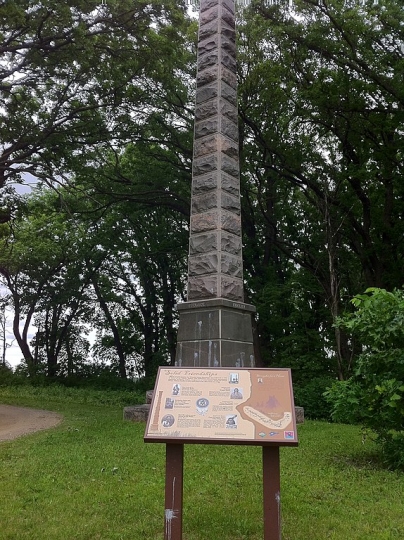
The St. Paul Pioneer Press publishes an interview with Jerome Big Eagle, one of the Dakota leaders at the battle. The same year, Minnesota erects a monument in nearby Morton that honors the Minnesota soldiers who participated in the battle.
Another monument is built near the first, honoring "Friendly Indians."
A memorial service is held on the battle site. Robert K. Boyd speaks about his experiences during the battle.
The Minnesota Historical Society begins developing the battlefield as an historic site.
Birch Coulee Battlefield Site opens to the public.
Made possible by the Arts and Cultural Heritage Fund through the vote of Minnesotans on November 4, 2008. Administered by the Minnesota Historical Society.
Minnesota Historical Society • 345 W. Kellogg Blvd., St. Paul, MN 55102-1906 (Map) • 651-259-3000 © MNHS.
Send questions or comments to mnopedia![[at]](/sites/all/modules/spamspan/image.gif) mnhs [dot] org. View our Privacy Policy.
mnhs [dot] org. View our Privacy Policy.